Remaining competitive in the digital space means leveraging data to boost your business at every opportunity. You might be surprised to learn just how much actionable information is at your fingertips if you know how to mine the data available to you.
For the convenience store operator looking to stand out from the competition, data can answer some key questions: Who is your competition, and how can you overcome their strategies to own the customer?
I recently had the chance to address a wonderful crowd at the Outlook Leadership Conference about this very issue.
Who is your competition?
Calculating how to best compete begins with knowing who you are competing against. You can start by putting yourself in the place of the customer along the customer journey. A customer has a need and undertakes a search to fill it. The search can be a neighborhood walk, a driving search or, increasingly, an online search.
Not long ago I tried this myself. I looked on Yelp for fuel near me and found 10 locations – but a closer look revealed only four competitors since many carry the same flag. Similarly, a search for coffee brought up 86 locations. And a broader search for food gave me a whopping 130 locations within two miles – and when I switched over to Doordash and Grubhub another 36 locations showed up that weren’t on Yelp.
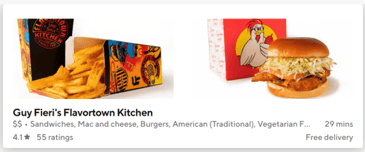 But wait. Why do DoorDash and Grubhub have listings that aren’t on Yelp? Well, some of those are “ghost kitchens.” This is a term that’s cropped up a lot lately and one that is having a major impact on any company dealing with delivery. I discovered two brands I had never seen before Guy Fieri’s flavortown kitchen and Mr. Beast Burger. It turns out they are virtual brands where you can only buy their food through delivery services (no dine-in) and the food is prepared in the kitchen of a well-known Italian chain Bertucci’s.
Three types of Ghost Kitchens are currently flourishing: Virtual brands like Guy Fieri’s; restaurants that are growing into new regional markets and trying out new brands; and third-party aggregators themselves, like DoorDash and Uber Eats. This means you have actually been battling for customers against competitors you couldn’t even see unless you went looking in your phone. That kind of competition calls for a significant digital strategy on your part.
How can you compete?
How can any brand compete on the delivery marketplaces when there are 166 listings within a 2 mile radius? What will it take to get to the top of search listings? It seems some brands are stacking the deck with ghost kitchens so they show up if you search for “Italian,” or “chicken” or “burgers.” This seems like a daunting task for any brand. What makes more sense is to change the rules to a game that is easier to understand, control and measure; you should own the customer.
How can you own the customer?
Now you know who you are competing with – and everyone is in a fight to own the customer. Fortunately, the data behind the most successful brands tells us their secrets.
- Anchor with a Strong Loyalty Program. Adhere to the key design principles of loyalty programs. Keep the program simple. Make it easy to enroll and easy to understand the program, track your points, and see daily deals and limited time offers. This will give you the insight and information you need to create the programs that keep customers coming back.
- Hone Your Ordering Strategy. Implement first-party ordering with a website and mobile app – but use third-party aggregators for delivery and customer acquisition. A first-party system gives you complete control while also enabling you to keep the customer information. Also important is to offer a choice of fulfillment. Today’s customers expect the option to choose from takeout, curbside, or delivery.
- Make Payment Easy. Ensure a painless payment process whether your customer is in person, visiting your online store, or ordering via mobile app. Leveraging Apple Pay and Google Payments (which is currently fee-free) can mean high conversion rates, speedy checkouts, and few errors. You also want to integrate your loyalty program with ordering so people can easily earn and redeem rewards.
- Personalize through Artificial Intelligence. AI can do incredible things, when used properly. We focus on what we call AI to IAsm, that is, using artificial intelligence to drive individual action. It can help you target the best times for reaching out and recapturing lapsed customers and can even predict a lapse before it happens. It can help you identify the best day of the week for offers and discounts – without compromising profits or traffic. And it can tailor campaigns to your individual guests based on their behavior.

Today’s marketplace is a double-edged sword – the pressure on businesses to compete with data and tech is higher than ever, but emerging tools are giving you the means to do so.
Do you have questions about how you can better leverage data to benefit your business? Our team can help. Book a demo today.

 Michelle Casey



 Jeff Hoover : Sep 25, 2019