
 Julia Bigwood
13 min read
Loyalty Trends 2024: Data Drives Performance
 Julia Bigwood : May 01, 2024
Key Takeaway: Using data, automation, and AI helps you understand your guests and create better loyalty programs.
How many brands measure guest visit frequency in some way, and how many have a goal of increasing guest frequency? In fact, frequency is a very common metric marketers use to describe their customer base.
To determine the true guest behavior behind this metric, Paytronix Strategy & Analytics conducted a study.
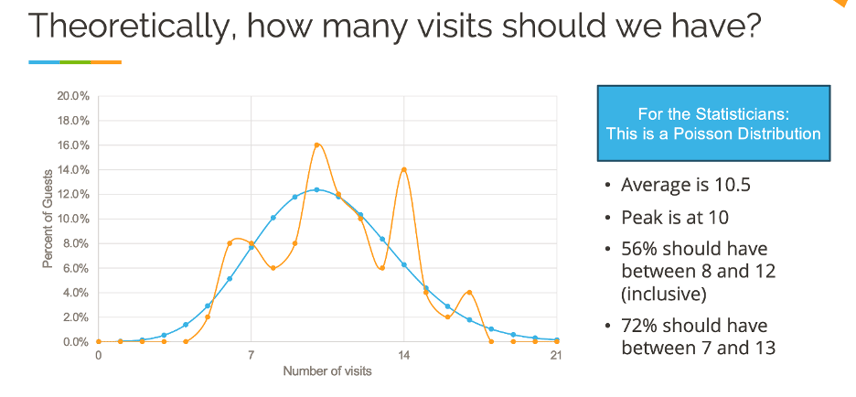
Two possible models for guest behavior were defined for a group of customers with a particular frequency. Next, real data from Paytronix loyalty programs was examined to determine which model is (more) correct. The goal was to provide Paytronix customers with an understanding of how guests really behave, and how that should impact marketing to drive frequency.
Following a cohort of guests who visit every X days on average, Paytronix found two possible models of guest behavior. Either guests visit on a consistent basis every six days (consistent) or guests make a daily decision every day over six days whether to visit or not (random).
S&A looked at the data in each scenario to see which is closer to the truth.
Next, Paytronix pulled a sample of 1000 accounts per client from a broad range of clients. Each account had between 8 and 12 visits between March 1st and May 2nd (a 63 day period). Customers also had to have at least one visit before that window, and at least one visit after.
If guest behavior was highly consistent, the data would find lots of guests with a minimum gap of five to six days. If guest behavior is random (or more specifically, follows a Poisson Distribution), then the most common gap between visits would be one day.
If guests were highly consistent, the data would indicate a peak around five to seven visits. In reality, Paytronix found that 60% of guests have at least one pair of visits that are on consecutive days.
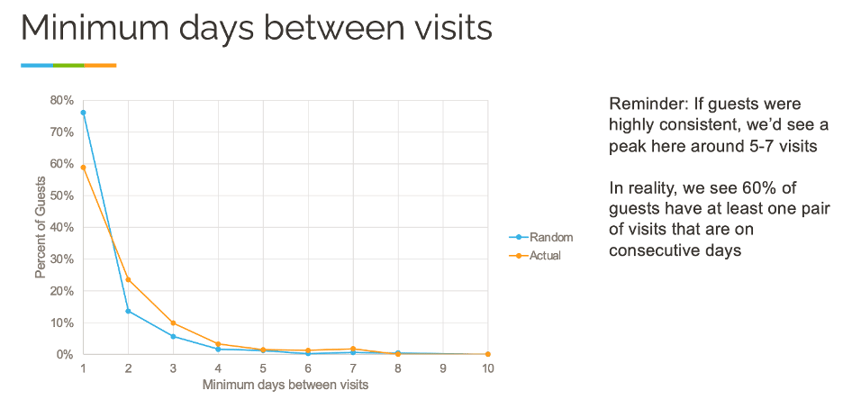
In fact, day one is the second most likely day to return, which reinforces marketing to “just pulling a visit forward.” Day seven is approximately 8% higher than it would be if this were a truly random process.
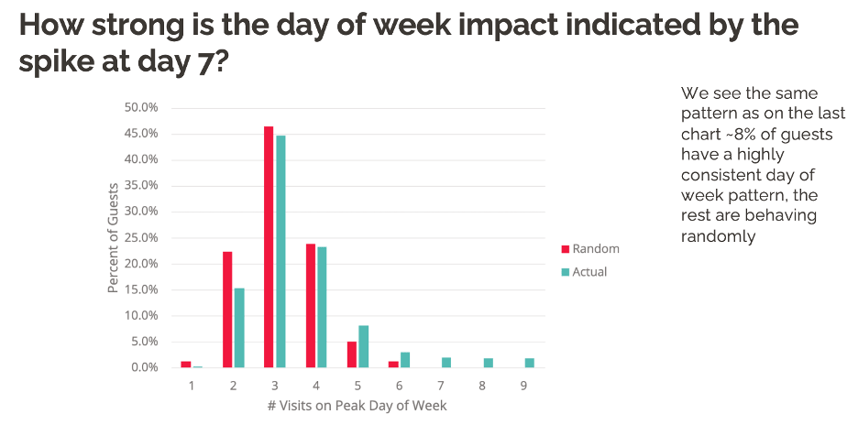
There are a handful of clients that have much larger spikes on day seven. These are brands that run a very strong weekly promotion to loyalty members. Convenience stores and coffee shops have relatively smaller spikes at day seven, and more on day one. We found that brands had very different overall frequency distributions, but once the data is controlled for frequency, guests tend to behave the same.
The classic idea of guests each having their own underlying frequency and then visiting consistently at that rate is not the way (most) guests behave. A much better mental model of how guests behave is that each guest has an n-sided die. Each morning they get up and roll it, and if it shows n, they visit a specific location.
Guests aren’t thinking, “it’s n days since I went to that brand, I’m due.” This isn’t a hair salon or a weekly personal training appointment. It’s a series of independent decisions. Consequently, frequency isn’t how guests think, it’s something we’ve invented to measure guests.
In fact, marketers are not really trying to drive frequency. Instead, they are trying to increase the probability that their guests choose to visit on any given day. In turn, these actions will increase frequency.
There’s little risk of marketing “just pulling forward a visit that was going to happen anyway.” Marketing to guests that visit on a 15-day cycle doesn’t make sense. Some day-of-week marketing can improve performance, but otherwise marketers must balance staying front-of-mind with being too intrusive.
13 min read
Julia Bigwood : May 01, 2024
Key Takeaway: Using data, automation, and AI helps you understand your guests and create better loyalty programs.
4 min read
Julia Bigwood : Jun 24, 2022
Although customer tastes are trending toward takeout, delivery customers remain a critical segment to embrace. That’s because one key learning from...
15 min read
Julia Bigwood : Feb 11, 2025
The difference between packed tables and empty seats often comes down to marketing. Staying ahead means getting guests to buy.