Planning the menu is the single highest-leverage decision a restaurant makes, and most operators treat it as a chore to get through rather than a quarterly discipline to run. The gap between those two approaches is measurable.
In a survey commissioned by Mastercard, 70% of restaurant leaders called menu optimization fundamental to their organizational goals, but only 27% said they apply high rigor to the analytical and financial work behind it. Nearly everyone agrees the menu decides profitability. Roughly a quarter actually plans like it does.
This guide is a deep dive into planning the menu restaurant operators actually need: the quarterly strategic cycle a restaurant business runs to revise its entire menu, and the separate one-off process of planning a dinner menu for a party or event. The mechanics differ sharply, so the sections are split. Menu planning for restaurant teams comes first.
The Two Contexts for Menu Planning
Restaurant menu planning optimizes individual menu items for profitability across hundreds of covers a week, constrained by food cost percentage, kitchen capacity, and supply chain reliability.
A restaurant offers the same dishes repeatedly, so a few dishes carrying bad margins compound into a real problem. Event menu planning optimizes for simultaneous execution (getting every plate out at once) and individual item margin barely matters.
If you are a restaurant operator, start with the quarterly framework below. If you are planning a party, skip ahead to the dinner menu section.
Menu Types: What Restaurants Choose and Why
Before planning the menu itself, decide what kind of menu you need. The structure affects everything downstream: how many dishes you prepare, how often you reprint, and how much flexibility the kitchen retains.
- À la carte menu: Every item is priced individually; this is the default for most full-service restaurants and the most flexible option for guests.
- Prix fixe: A set multicourse meal at one price, common in upscale restaurants and for events, allowing tighter cost control and more coordinated kitchen service.
- Du jour: Daily offerings based on available ingredients, prioritizing freshness but increasing printing and training requirements.
- Cycle menu: A rotating set of dishes that repeats on a fixed schedule, standard in institutional foodservice and useful anywhere demand is predictable.
- Static or fixed menu: The same items year-round, which maximizes consistency and supplier leverage while limiting seasonal opportunities.
Most restaurants choose a hybrid: a static core of popular dishes with a seasonal or du jour section layered on top. That structure gives you the supply chain predictability of a fixed menu and the novelty of a changing one, which is usually a practical balance for a restaurant business managing both priorities.
Restaurant Menu Planning: A Quarterly Strategic Framework
A well-planned menu is not written in an afternoon. The operators who get the most from planning a menu follow a six-to-eight-week cycle, four times a year, with a defined sequence. The five phases below map to that cycle.
Everything starts with the menu concept, which should align with your broader restaurant concept. Before any item is chosen, the menu has to serve the restaurant’s business goals and reflect its brand.
A menu that feels disconnected from the dining room can confuse guests before the food arrives. Know your audience well enough to understand what they order on a Tuesday versus a Saturday.
The benefits of this discipline compound. Menu planning benefits can be seen in food costs, labor, waste, and average ticket size simultaneously, because each depends in part on which dishes you offer and how you price them.
Done well, a revised menu can attract new customers and give regulars a reason to return. Food enthusiasts may also respond to a menu that has been visibly refreshed.
Phase 1: Menu Audit and Performance Review (Weeks 1–2)
You cannot plan a new menu without knowing how the current one performed. This phase focuses on data collection, and the order matters:
- Pull POS sales volume by item for the last 90 days: Use actual counts, not staff impressions of what is popular.
- Run a food cost report by item: Compare what each dish actually cost to produce with its selling price.
- Review customer feedback for patterns: Examine Google reviews, comment cards, and server input, looking for repeated themes rather than one-off complaints.
- Categorize every item on the menu using the menu engineering matrix.
That last step is the one that converts data into decisions. Menu engineering sorts items into four quadrants: Stars (popular and high-margin), Plow Horses (popular, low-margin), Puzzles (high-margin, low popularity), and Dogs (low-margin and low popularity).
Paytronix uses its own labels (Performers, Spark Plugs, Hidden Gems, and Underperformers) for the same four categories.
Ask three managers which dishes to cut, and you may get three different answers. The sales report provides an objective starting point. This is also where you might discover that the dish everyone on staff loves sells only four orders a week.
Phase 2: Seasonal Opportunity and Trend Identification (Week 3)
With the audit complete, look outward. Seasonal dishes built around produce entering peak season can cost less and taste better at the same time, creating an opportunity for margin and quality to improve together. Local ingredients bought in season can reduce both ingredient costs and delivery distances.
Three inputs shape this phase.
First, identify which produce will be in season in your region over the next quarter.
Second, determine which emerging trends are genuinely relevant to your customer base rather than just visible on social media. Health-focused and plant-based dishes have moved from novelty to expectation in most markets.
Third, review what nearby competitors are doing to identify potential gaps in the local market.
The industry has moved decisively toward frequent menu changes. Technomic found that limited-time offers grew 36% year over year and 128% across five years, outpacing core menu growth.
Changing the menu as the seasons change is no longer a differentiator; it is the baseline. What still differentiates restaurants is making those changes based on data rather than instinct.
Phase 3: New Item Development and Costing (Weeks 4–6)
This is where new dishes are developed, and where many should be eliminated. Give yourself six to eight weeks from here to launch. Remember that recipe development, sourcing, costing, photography, print production, and staff training all have to fit within that timeline.
- Develop new menu items against identified gaps: Seasonal ingredients, dietary preferences you do not currently accommodate, or a price tier your menu offerings do not currently cover.
- Cost every item at recipe level before approval: Include every component, including garnish, sauce, and packaging
- Run a kitchen feasibility test: Can the dish be prepared at full service volume without creating a bottleneck?
- Train kitchen and front-of-house staff before launch, not during it
On pricing: a typical food cost percentage target ranges from 28% to 35%, with quick-service restaurants targeting lower percentages and upscale restaurants higher ones because premium ingredients cost more. Divide the ingredient cost by your target percentage to get the target menu price based on food cost, then check that number against what your market is willing to pay.
A dish can be excellent and still be unsuitable for your menu if the calculated price exceeds your target price range.
Two additional operational constraints determine which dishes make the final menu. Complex dishes raise kitchen labor costs and slow service, so a technically impressive dish can fail because of excessive ticket times. Ingredient availability also matters: a dish built around an ingredient your supplier stocks inconsistently can disrupt your menu’s consistency when it becomes unavailable.
Using ingredients across multiple dishes solves several problems at once. It reduces storage space requirements, cuts food waste, and shortens your order guide.
Menu descriptions also deserve attention. Sensory language describing texture, aroma, and cooking methods builds anticipation and influences customers’ perceptions of value, which is why “slow-braised short rib with charred scallion” may be more appealing than “braised beef.”
Keep each description to a line or two.
Phase 4: Digital Testing Before Print Launch (Week 6–7)
This step reflects how restaurant menu planning has evolved. Before committing anything to print, put the new items on your online menu first and monitor their performance.
Add the candidates to the digital ordering menu, test them for one to two weeks, and review actual order volume. This shows which items guests choose without staff recommendations, avoids printing costs, and allows you to remove dishes that underperform.
A connected digital system can let you add, remove, and reprice items across multiple platforms at once, so the test may require only a few minutes of setup instead of another print run.
This reverses the traditional risk. Printing a menu previously meant committing to changes before knowing how they would perform. By testing digitally first, you can build the printed menu around items that have already demonstrated demand.
Phase 5: Full Menu Launch and Communication (Week 8)
Even a well-designed new menu can underperform if customers do not know about it.
Launch week has five moving parts: completed staff training, printed menus delivered and checked, digital menus and menu templates updated across every channel, a social media announcement featuring high-quality images of the new dishes, and a notification to loyalty program members.
That last step is often overlooked. Loyalty members are among the guests most likely to return to try something new, and messaging them during launch week can generate a stronger response than a general social media post.
Paytronix data shows brand-controlled digital menus generate 15–20% higher average tickets than third-party alternatives, and launch is when that gap is widest.
Then check that your printed and online menus match. Inconsistent pricing across channels, such as a price updated on one menu but not another, creates friction that can undermine a positive dining experience.
A Note on Menu Layout and Design
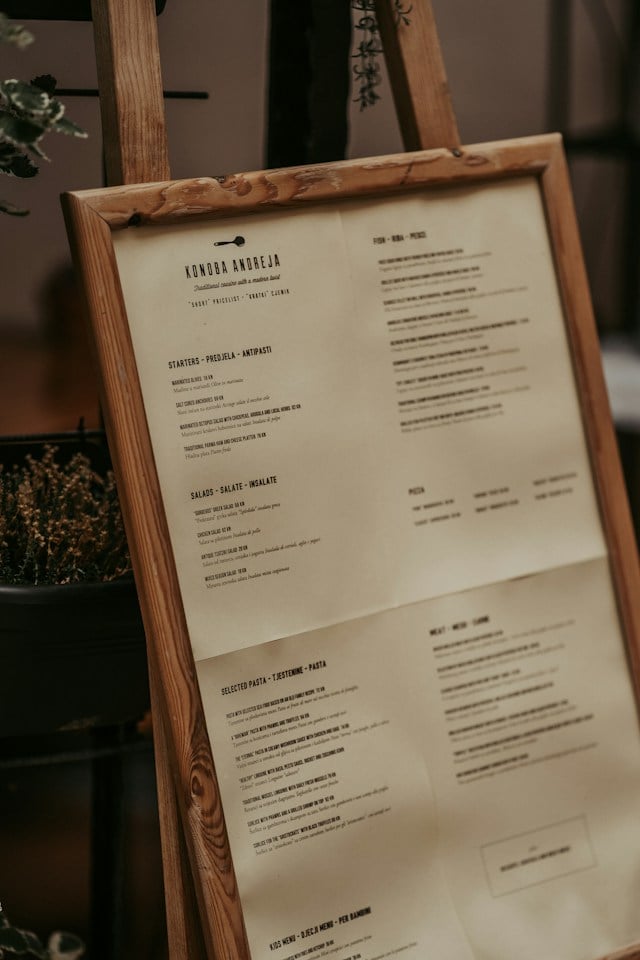
Restaurant menu design is where planning becomes visible to the guest, and it should complement your restaurant’s design rather than conflict with it. Menu layout influences what gets ordered: items given a box, white space, or an icon may be chosen more often than identical items in a plain list.
Keep each menu section to roughly seven items, use two fonts at most, and vary the visual elements so the page has a clear hierarchy.
One widely repeated claim deserves clarification. You may have read that diners look at the upper-right corner first, so your popular and highest-margin dishes belong there.
When San Francisco State researcher Sybil Yang tracked diners’ eyes with an infrared scanner, she found no such sweet spot. People read menus sequentially, like a book. Emphasis drives orders, not position.
Menu prices deserve the same care. Cornell researchers found that diners spent about 8% more, or $5.55 per check, when menus omitted dollar signs, so list plain numbers and keep them aligned rather than placing them after dotted leaders.
Review the full menu design whenever you revise the menu, since a layout built for 40 items may no longer work at 55.
Planning a Dinner Menu for a Party or Event
Planning a dinner menu for an event involves one constraint that differs from everyday restaurant planning: serving multiple dishes at the same time.
Can every dish be plated and served within the same 10- to 15-minute window, given your guest count and available equipment? That question governs everything, which is why planning a party menu differs from planning menus for a restaurant.
If you want to know how to plan a dinner menu, how to create a dinner menu, or how to plan a menu for a party specifically, the three steps below cover the process. A DIY dinner menu for twelve and a catered event for eighty follow the same logic at different scales.
Step 1: Determine Constraints Before Choosing Dishes
Before choosing dishes, document five key constraints: guest count; confirmed dietary restrictions; service style (plated, buffet, or family-style); kitchen and equipment capacity, including oven space and available burners; and budget per person.
Service format has the greatest influence on the rest of your planning. Plated service requires more labor but gives you greater control over portions and presentation. Buffet service requires less labor but makes portions and costs harder to control. Family-style service falls between the two and suits many home events.
Choose the service format first because it determines how many different dishes you can realistically prepare and serve.
Step 2: Apply the 3-3-3 Framework
For most home and event kitchens, a simple structure works better than an overly ambitious menu: three appetizers, three mains, and three desserts. Within that, make at least one appetizer vegetarian and at least one main meat-free, which covers some common dietary preferences without requiring separate menus.
Nine items may sound modest, and that is the point. The research on choice is clear. In the classic study by Sheena Iyengar and Mark Lepper, shoppers offered six jam varieties bought more often than those offered 24, and reported more satisfaction with what they picked.
The same logic is why restaurant menus work best at roughly seven items per menu section. Too many dining options can create decision fatigue rather than improve the experience.
Build variety into the nine dishes rather than adding a tenth. Vary the flavor profiles, mix the cooking methods so you are not competing for one oven, include gluten-free and vegetarian options, and vary the visual elements on the plate. Color and height can improve presentation more than adding another component.
Step 3: Test Everything Before the Event
A dish that works for six guests often fails when prepared for thirty. Timing and holding requirements change, quantities do not always scale linearly, and plating that was quick for six can become a bottleneck. Run a full recipe test at or near your actual guest count, two to three weeks before the event.
That lead time is deliberate. It leaves room to replace a dish that does not scale, source a different ingredient, or adjust a recipe, none of which is easy to do the day before.
For a formal event, a custom dinner menu template printed for the table is a nice touch, but finalize it only after the test, since testing determines which dishes will be served.
Creating a dinner menu this way takes longer than improvising, but it can make the event considerably easier to manage. In short, to make a dinner menu that works, establish your constraints, choose nine dishes, test them at scale, and then create a menu card for the table.
How AI Is Changing Restaurant Menu Planning in 2026
AI adoption in restaurant menu planning is growing, although it remains uneven. The National Restaurant Association’s 2026 State of the Restaurant Industry report found that 26% of operators now using AI tools, concentrated in marketing (19% of full-service and 15% of limited-service operators) with 10% applying it to administrative work and 6% to customer orders.
Four capabilities matter specifically for menu planning. POS-based performance analysis can automate the Phase 1 audit, classifying every item by popularity and margin without requiring a spreadsheet.
Competitive menu monitoring tracks what nearby restaurants add, remove, and reprice. Seasonal trend identification identifies trends gaining traction in your category before they become widely apparent.
Pricing optimization also suggests adjustments based on cost changes and demand elasticity rather than a flat percentage increase.
These remain emerging tools rather than established practices. Consumer data platforms and AI analysis can reduce the time spent on analytical work, which many operators struggle to prioritize, but they do not replace judgment about which items belong on the menu.
A Mastercard survey found that 82% of restaurant professionals believe measuring true revenue impact is essential while only 16% say their organization does so proficiently. These tools aim to close that gap, potentially delivering greater value than any individual menu addition.
Treat AI as a way to make rigorous analysis more manageable, not as a substitute for the restaurant concept behind the menu. A great menu still comes from knowing your target customers and your restaurant’s identity. These tools can reduce the cost and effort of evaluating your decisions.
Frequently Asked Questions About Menu Planning
How long does menu planning take for a restaurant?
Plan for 8 to 12 hours of focused work spread across a six-to-eight-week cycle for a quarterly seasonal update. That covers the audit, development, costing, testing, and launch preparation.
Many restaurants invest far less, spending only a few hours choosing new dishes, which may limit the menu’s earning potential. The work is not continuous; it is concentrated in the audit and costing phases.
When should I start planning a new restaurant menu?
Six to eight weeks before your target launch date, at minimum. That window has to accommodate recipe development, recipe costing, supplier sourcing and sample approval, food photography, staff training on every new item, and print production lead times.
Shortening this timeline increases the risk of skipping important steps, particularly costing or training, which can create more expensive problems later.
How do I plan a dinner menu for a party?
Start with constraints, apply the 3-3-3 framework, then test at scale. Lock down guest count, dietary needs, service format, kitchen capacity, and budget first. Then choose three appetizers, three mains, and three desserts, with vegetarian options built in. Finally, prepare the full menu at or near your actual guest count two to three weeks before the event so you can identify and resolve problems in advance.
Plan the Menu and Give It a Platform That Makes Every Update Easy
A successful restaurant does not finish planning the menu. It cycles: audit, develop, cost, test, launch, and back to audit a quarter later. The operators pulling ahead are the ones who shortened that loop, testing new dishes on the digital menu in days rather than committing to print and waiting for a quarterly report to tell them what happened.
That requires a platform that connects the menu, ordering channels, and guest data rather than managing them as separate systems.
Request a Paytronix demo to see how digital ordering turns menu planning into a continuous, data-driven process instead of a periodic print update and how loyalty data helps identify which items encourage return visits, rather than simply tracking which dishes sell.
For a shorter walkthrough of the core process, see our guide on how to plan a menu. For the mechanics of building the document itself, start with menu making, and for the financial considerations, see our article on restaurant profit margin.

 Julia Bigwood
 Julia Bigwood : Aug 28, 2026