Restaurant loyalty software is a digital platform that helps restaurants create, manage, and optimize guest rewards programs. The best platforms combine loyalty, CRM, online ordering, and AI-powered personalization in a single suite. Leading options include Paytronix, PAR/Punchh, Toast Loyalty, Thanx, and Incentivio, each suited to different restaurant sizes and operational needs.
Overview
Choosing restaurant loyalty software is harder than it looks. The market is crowded, vendor claims are nearly identical, and the real differences between platforms only surface once you're deep into a demo or, worse, six months into an implementation that isn't working.
This guide cuts through that noise. It compares six leading restaurant loyalty platforms across seven criteria that matter most to operators: integration depth, AI capabilities, segmentation, channel coverage, pricing model, support structure, and scalability. Each platform is assessed factually and fairly.
Paytronix has worked with more than 1,800 restaurant and c-store brands across 50,000 locations globally for over 20 years. The data and perspective in this guide draw on that experience including findings from the 2026 Paytronix Loyalty Report, which analyzed active rate trends and guest behavior benchmarks across hundreds of brands.
In This Guide
- What restaurant loyalty software is and how it works
- The 7 evaluation criteria that separate good platforms from great ones
- Profiles of 6 leading platforms: features, strengths, and honest limitations
- Side-by-side comparison table across all criteria
- Answers to the 8 most common questions buyers ask
- Recommended next steps
Top Restaurant Loyalty Platforms at a Glance
Use this table as a starting point. The full platform profiles and expanded comparison table appear in the sections below.
|
Platform
|
Best For
|
Key Differentiator
|
Pricing Model
|
|
Paytronix
|
Multi-unit and enterprise restaurants and c-stores
|
Unified platform: loyalty, ordering, CRM, gift, and AI in one data model
|
Contact for pricing
|
|
PAR / Punchh
|
Enterprise QSR and fast casual chains
|
Deep POS integration, unified guest identity, AI-driven rule activation
|
Contact for pricing
|
|
Toast Loyalty
|
Independent and SMB restaurants on Toast POS
|
Native POS integration, quick setup, low friction enrollment
|
~$185/mo (bundled)
|
|
Thanx
|
Restaurant brands prioritizing card-linked loyalty
|
No-app, card-linked model; strong lapsed guest reactivation
|
Contact for pricing
|
|
Incentivio
|
Growing multi-unit chains seeking all-in-one
|
Mobile-first platform with built-in ordering, loyalty, and CRM
|
Contact for pricing
|
|
Square Loyalty
|
Small restaurants already on Square POS
|
Simplest setup in the market; fast activation
|
From $49/mo
|
Why Picking the Wrong Loyalty Platform Is Costly
The Core Challenge
Restaurant operators are under pressure from every direction — rising food costs, tighter labor markets, and third-party delivery platforms that have quietly inserted themselves between brands and their own guests. Loyalty software is supposed to help reclaim that relationship.
But the wrong platform makes things worse: fragmented guest data, low enrollment rates, disconnected marketing channels, and expensive implementations that never fully deliver.
The stakes are measurable. Loyalty program members visit 20% more often and spend 20% more per check than non-members, according to industry retention data. That delta compounds over time — it's the difference between a guest worth $400 per year and one worth $576. Multiply that across thousands of guests and the choice of platform becomes a significant business decision, not a software purchase.
76% of limited-service restaurants reported an increase in traffic in 2024 directly attributable to their loyalty program, per Nation's Restaurant News. That number should be a floor, not a ceiling — but only if the platform behind it supports the right capabilities.
What's Changed Recently
Two things have fundamentally shifted the loyalty software landscape since 2024. First, AI-powered personalization has moved from a premium add-on to a baseline expectation. Platforms that can only offer batch-and-blast email campaigns are visibly outperformed by those with behavioral trigger campaigns, predictive churn models, and 1:1 offer generation. Restaurants using AI-powered personalization see up to 35% higher redemption rates compared to traditional segmentation approaches.
Second, the shift to first-party data ownership has become critical. Third-party delivery platforms (DoorDash, Uber Eats, Grubhub) process billions of restaurant transactions annually without sharing guest identity data with the brands those guests are ordering from.
Loyalty software that captures first-party data across every channel (in-store POS, online ordering, mobile app, delivery) is now the primary tool for rebuilding direct guest relationships. Platforms that don't offer seamless first-party data capture across all channels are a structural liability.
What Good Looks Like
A restaurant brand with the right loyalty platform in place knows exactly who its top 20% of guests are, what they ordered last, when they're likely to churn, and what offer will bring them back before they do. Campaigns launch in minutes, not days.
Enrollment happens at every touchpoint and every interaction enriches the same guest profile. Marketing ROI is measurable at the transaction level, not estimated from aggregate metrics.
That is achievable. The platforms below represent the current state of that possibility.
What Is Restaurant Loyalty Software?
Primary Definition
Restaurant loyalty software is a digital platform that enables restaurants to design, launch, and manage structured guest rewards programs. It tracks guest behavior across channels, delivers personalized incentives through email, SMS, push, and in-app messaging, and connects directly with POS and online ordering systems to make reward earning and redemption frictionless at every touchpoint.
How It Works
At its most basic level, loyalty software intercepts the transaction. When a guest makes a purchase — at a POS terminal, through an online ordering site, or via a mobile app — the software records who made the purchase, what they bought, how much they spent, and when they visited. Those data points build a guest profile over time.
The profile is what gives loyalty software its leverage. A guest who has visited three times in 30 days is not the same marketing target as a guest who visited once in 90 days. Loyalty software uses those behavioral differences to trigger the right message, at the right time, through the right channel — automatically and at scale.
The most advanced platforms layer AI on top of this behavioral data. Instead of manually building campaign segments, the platform predicts which guests are likely to churn, which offer will drive the next visit, and which channel will produce the highest redemption rate. The system learns and improves with every interaction.
Key Terminology
-
Loyalty Program: A structured system that rewards guests for repeat visits or purchases, typically through points, discounts, free items, or exclusive experiences.
-
Points-Based Rewards: A loyalty structure where guests earn a set number of points per dollar spent or per visit, redeemable for rewards once a threshold is reached. The most common program type in restaurant loyalty.
-
Tiered Program: A loyalty structure that assigns guests to levels (e.g., Bronze, Silver, Gold) based on cumulative spend or visit frequency. Higher tiers unlock better rewards and drive aspirational behavior.
-
Subscription Program: A paid recurring membership that grants guests a defined set of benefits in exchange for a fixed monthly or annual fee. Growing rapidly in QSR and fast casual segments.
-
Campaign Center: The marketing automation hub within a loyalty platform — where operators build, schedule, and deploy targeted campaigns to defined guest segments based on behavioral triggers.
-
Visit Frequency: The average number of times a loyalty member visits within a defined period, typically 90 days. One of the primary performance metrics for loyalty program health.
-
Active Rate: The percentage of enrolled loyalty members who have made at least one qualifying purchase within a defined window (usually 90 days). A critical measure of program engagement quality.
-
Churn Prediction: An AI-driven model that identifies guests whose visit frequency is declining, enabling proactive win-back campaigns before the guest is fully lapsed.
-
First-Party Data: Guest behavioral and transactional data collected directly by the restaurant; owned by the brand, not a third party. The foundation of personalized loyalty marketing.

Types of Restaurant Loyalty Programs
- Points-based: Guests earn points per dollar spent or per visit. Widely used, easy to understand, and effective across QSR, fast casual, and full service.
- Visit-based (punch card digital): Guests earn a reward after a set number of visits. Simple to run, best for high-frequency, lower-check concepts.
- Tiered: Multi-level structure that escalates rewards as guest spending increases. Drives incremental spend and creates aspirational behavior.
- Subscription: Recurring monthly or annual membership with defined benefits. Creates predictable revenue and builds habitual visit behavior.
- Card-linked: Guests earn rewards automatically when they pay with a linked credit or debit card — no app download required. Lowers enrollment friction significantly.
- Hybrid: Combination of two or more program structures tailored to a brand's specific guest mix and operational goals.
Evaluation Criteria
Before comparing platforms, it helps to know what actually separates them. The seven criteria below are the ones that most directly affect program performance, operational simplicity, and long-term scalability.
The 7 Criteria That Matter
-
POS Integration Depth: A loyalty platform that integrates natively with your POS — without middleware — is faster to deploy, more reliable, and captures more complete transaction data. Middleware integrations introduce latency, data gaps, and an additional vendor to manage. Count the number of native POS integrations and ask whether your specific POS is supported.
-
AI and Personalization Capabilities: The difference between a platform that sends the same coupon to every lapsed guest and one that generates a personalized offer based on each guest's order history, preferred channel, and predicted churn probability is measurable in redemption rates and program ROI. Ask specifically about what the AI does, not just whether it exists.
-
Segmentation Granularity: Pre-built audience segments are a starting point. The best platforms support custom behavioral segments like visit frequency, average check, menu preferences, last visit date, and geographic cluster without requiring developer involvement.
-
Omnichannel Messaging: Email, SMS, push notification, and in-app messaging should all be native — not bolt-on integrations with third-party ESPs that create data silos and attribution gaps. Ask whether each channel is natively built or third-party managed.
-
Data Ownership and Portability: Who owns the guest data? Can you export it at any time, in any format, without penalty? This question is especially important for brands that may switch platforms or run analytics outside the loyalty system.
-
Program Design Flexibility: Can the platform support the program structure your concept actually needs — not just the default structure the vendor wants to sell? Look for support for points, tiers, subscriptions, challenges, gamification, and comp programs within a single platform.
-
Support Model and Strategic Services: Software onboarding is the beginning, not the end. Platforms with dedicated engagement strategists, not just a help desk, help brands achieve significantly higher active rates and program participation. Ask what strategic support is included vs. charged separately.
Platform Profiles
Paytronix
|
|
|
|
Overview
|
Paytronix is a cloud-based guest engagement suite serving more than 1,800 restaurant and c-store brands across 50,000+ locations globally. Founded in 2001, the platform unifies loyalty, online ordering, gift and comp cards, CRM, AI-driven marketing automation, and mobile apps in a single data model. It's owned by The Access Group.
|
|
Best For
|
Multi-unit and enterprise restaurant and c-store brands that want an all-in-one guest engagement platform with deep AI personalization, a broad integration library, and embedded strategic support.
|
|
Key Strengths
|
Unified data model across loyalty, ordering, gift, and CRM — no cross-platform data reconciliation required. 450+ integrations including 30+ native POS integrations. AI-powered churn prediction, personalized offer generation, and 1:1 messaging at scale. Best clients achieve 50–70% loyalty participation rates. 1:1 messaging with AI increases campaign effectiveness by 400–500% over batch campaigns. Strategy & Analytics team included as part of platform offering.
|
|
Limitations
|
Pricing is not publicly listed — best suited to operators with the budget for enterprise-tier platforms. Implementation timeline is more substantial than simpler POS-native solutions. Smallest single-location operators may find the platform more extensive than needed.
|
|
Pricing
|
Contact for pricing. Custom-quoted based on brand size, product modules selected, and location count.
|
|
Notable Use Cases
|
Dutch Bros Coffee (1.4 million new loyalty members in one month at program launch). Legal Sea Foods (60% loyalty membership growth within two weeks of launching a CLV campaign). 1,800+ brands across restaurant and c-store verticals.
|
PAR / Punchh (PAR Engagement)
|
|
|
|
Overview
|
PAR Technology acquired Punchh in 2021 for $500 million, combining Punchh's loyalty platform with PAR's POS and back-office infrastructure. In 2025, PAR launched PAR Engagement, a unified platform bringing together Punchh Loyalty, marketing & offers, online ordering, and guest data in a single ecosystem. PAR serves 140,000+ restaurant locations globally.
|
|
Best For
|
Enterprise QSR and fast casual chains, particularly brands already in the PAR technology ecosystem (Brink POS), that want deep loyalty and marketing integration with their POS and back-office infrastructure.
|
|
Key Strengths
|
Punchh is one of the longest-tenured enterprise loyalty platforms in the restaurant industry. PAR Engagement's 2025 release adds unified guest identity across loyalty and non-loyalty guests, a significant capability gap that most platforms don't address. AI-driven rule activation, gamification tools (scratch-offs, spins, challenges), wallet-native loyalty via Smart Passes (Apple/Google Wallet), and subscription program support. Blue-chip client roster includes Yum! Brands, TGI Fridays, and Casey's.
|
|
Limitations
|
Full platform capability requires commitment to the broader PAR ecosystem. Pricing is custom-quoted and enterprise-positioned. Some operators report implementation complexity for multi-brand configurations. The 2025 PAR Engagement rebrand consolidates multiple acquisitions. Integration maturity across all modules continues to develop.
|
|
Pricing
|
Contact for pricing. Enterprise-positioned; pricing reflects scale.
|
|
Notable Use Cases
|
Yum! Brands, Fazoli's, TGI Friday's, Casey's, Robeks. More than 100 million U.S. adults interact with Punchh-powered loyalty programs.
|
Toast Loyalty
|
|
|
|
Overview
|
Toast is a restaurant POS company that offers loyalty as part of its Marketing Essentials bundle. Toast Loyalty is a points-based program built natively into the Toast POS ecosystem, with integration across Toast's online ordering, kiosk, guest-facing display, and mobile ordering products. Toast serves hundreds of thousands of restaurant locations across the U.S.
|
|
Best For
|
Independent restaurants, small chains, and SMB operators already running Toast POS who want loyalty integrated into their existing system with minimal setup time.
|
|
Key Strengths
|
Native POS integration. Loyalty is built into the same system operators already use. Quick setup; enrollment via phone number, email, or linked payment card at checkout. Works across Toast Online Ordering, Toast Kiosk, and Toast Go 2 handheld. Includes gift cards and email marketing in the Marketing Essentials bundle.
|
|
Limitations
|
Loyalty is only available within the Toast ecosystem. Positioned as a module within Toast, not a standalone loyalty platform. Segmentation and AI personalization are more limited compared to dedicated loyalty platforms. The $185/month Marketing Essentials bundle adds meaningfully to already substantial Toast POS costs. Limited strategic services support.
|
|
Pricing
|
~$185/month as part of the Marketing Essentials bundle (includes loyalty, gift cards, and email marketing), on top of base Toast POS subscription fees.
|
|
Notable Use Cases
|
Most effective for independent restaurants and small chains (1–20 locations) already committed to the Toast POS platform.
|
Thanx
|
|
|
|
Overview
|
Thanx is a guest engagement and loyalty platform that built its reputation on card-linked loyalty, a model that recognizes guests when they pay with a linked credit or debit card, without requiring a dedicated app download. Thanx serves restaurant brands across QSR, fast casual, and full service segments.
|
|
Best For
|
Restaurant brands prioritizing frictionless enrollment and lapsed guest reactivation, particularly those whose guests have historically resisted app-based loyalty programs.
|
|
Key Strengths
|
Card-linked loyalty eliminates the app download barrier — guests enroll once and earn automatically on every qualifying purchase. Strong lapsed guest reactivation capabilities. Marketing automation tools with behavioral trigger campaigns. Guest recognition system identifies top customers for personalized perks.
|
|
Limitations
|
Card-linked loyalty depends on payment card tokenization; guests not using their linked card on a visit don't earn. Push notification and in-app engagement are structurally limited compared to app-based platforms. Less comprehensive as a full guest engagement suite. Focused primarily on loyalty and offers rather than online ordering or gift card infrastructure.
|
|
Pricing
|
Contact for pricing. Custom-quoted.
|
|
Notable Use Cases
|
Restaurant brands seeking to increase loyalty enrollment rates by removing the app-download requirement.
|
Incentivio
|
|
|
|
Overview
|
Incentivio is an all-in-one digital guest engagement platform designed for multi-unit restaurant brands. The platform combines loyalty, online ordering, CRM, and mobile app capabilities in a single suite, with a strong emphasis on mobile-first guest experiences and direct ordering channel growth.
|
|
Best For
|
Growing multi-unit restaurant chains (20–200+ locations) seeking to consolidate loyalty, online ordering, and CRM in a single mobile-native platform — particularly brands trying to reduce dependence on third-party delivery apps.
|
|
Key Strengths
|
Fully branded mobile apps with loyalty, ordering, and CRM integrated. Omnichannel campaign tools across email, SMS, and push. Supports QSR and fast casual brands with complex multi-location configurations. Focus on direct ordering channel conversion — reduces third-party delivery dependence. Good fit for brands scaling from regional to national.
|
|
Limitations
|
Less established than Paytronix or PAR/Punchh in terms of market tenure and case study depth at the largest enterprise tier. Integration library not as extensive as platforms with 20+ years in the market.
|
|
Pricing
|
Contact for pricing. Custom-quoted based on location count and modules selected.
|
|
Notable Use Cases
|
Regional and national fast casual and QSR brands in the 20–500 location range.
|
Square Loyalty
|
|
|
|
Overview
|
Square Loyalty is a points-based loyalty add-on built into the Square POS and payment ecosystem. It's designed for small to mid-sized restaurants and food businesses that want a simple, fast-to-deploy program without complex configuration or long implementation timelines.
|
|
Best For
|
Small and independent restaurants already using Square POS and payment processing that want a straightforward loyalty program at a low monthly cost with minimal setup.
|
|
Key Strengths
|
Lowest cost of entry of any platform in this comparison. Guests enroll via phone number at checkout; immediate and frictionless. Flexible reward tiers (visits or dollars). Automated reminders when guests are close to earning a reward. Fully native to the Square ecosystem.
|
|
Limitations
|
Only usable with Square POS; not available to restaurants on other payment platforms. Segmentation, AI personalization, and campaign automation are basic compared to enterprise platforms. Not designed for multi-unit operators with complex program requirements or multi-concept configurations. Limited strategic support.
|
|
Pricing
|
From $49/month per location.
|
|
Notable Use Cases
|
Single-location cafes, food trucks, QSRs, and small restaurant groups using Square for payments.
|
Side-by-Side Comparison: All 6 Platforms
Ratings reflect relative capability within this competitive set, not absolute product quality. ★★★★★ = strongest within peer group.
|
Platform
|
POS Integration
|
AI and Personalization
|
Segmentation
|
Omnichannel Messaging
|
Program Flexibility
|
Strategic Support
|
Best Fit
|
|
Paytronix
|
★★★★★ (450+ integrations, 30+ POS native)
|
★★★★★ (churn prediction, 1:1 offers, AI campaigns)
|
★★★★★ (deep behavioral + predictive)
|
★★★★★ (email, SMS, push, in-app — all native)
|
★★★★★ (points, tiers, subscriptions, challenges, comp)
|
★★★★★ (dedicated engagement strategists)
|
Multi-unit enterprise, c-store
|
|
PAR / Punchh
|
★★★★★ (deep Brink POS native; broad 3rd party)
|
★★★★ (AI rule activation, predictive offers)
|
★★★★ (loyalty + non-loyalty guest segmentation)
|
★★★★ (email, SMS, push, wallet-native)
|
★★★★ (points, tiers, subscriptions, gamification, wallet passes)
|
★★★★ (loyalty strategists available)
|
Enterprise QSR, fast casual
|
|
Toast Loyalty
|
★★★ (native Toast only; not cross-POS)
|
★★ (basic; limited predictive capability)
|
★★ (basic segmentation)
|
★★ (email in bundle; limited push/SMS)
|
★★ (points only; limited program types)
|
★★ (standard support)
|
SMB, independent, Toast-committed
|
|
Thanx
|
★★★ (card-linked; POS-agnostic enrollment)
|
★★★ (behavioral triggers, lapsed reactivation)
|
★★★ (behavioral targeting)
|
★★★ (email, SMS, push via app)
|
★★★ (card-linked + app; limited ordering integration)
|
★★★ (account management)
|
App-resistant audiences, reactivation focus
|
|
Incentivio
|
★★★ (growing integration library)
|
★★★ (behavioral automation, campaign tools)
|
★★★ (multi-location configurations)
|
★★★★ (mobile-first; email, SMS, push)
|
★★★ (loyalty + ordering + mobile app)
|
★★★ (onboarding + ongoing support)
|
Growing multi-unit (20–200 locations)
|
|
Square Loyalty
|
★★ (Square only; not cross-POS)
|
★ (no predictive AI)
|
★ (basic; visit or spend only)
|
★ (automated reminders only)
|
★★ (points and visit-based only)
|
★ (self-service)
|
Single-location, Square POS users
|
Paytronix Research: What the Data Says About Loyalty Program Performance
Loyalty members spend 38% more per visit than non-members
Paytronix Research, 2025
That figure comes from Paytronix platform data aggregated across hundreds of brands and it represents the most direct argument for loyalty investment. A guest who spends $22 per visit becomes a guest worth $30.36 per visit after enrolling in a loyalty program.
The program doesn't change what's on the menu. It changes the guest's relationship with the brand.
Best Paytronix clients achieve 50–70% loyalty participation rates
Paytronix Platform Data, 2025 — vs. industry average of ~20%
The participation rate gap matters more than most operators realize. A brand with 10,000 active guests and a 20% enrollment rate has 2,000 loyalty members.
A brand with the same guest count and a 60% enrollment rate has 6,000 members; three times the marketing addressable audience, producing three times the behavioral data for targeting, three times the campaign reach, and three times the revenue attributable to loyalty. Enrollment rate is the single biggest lever in loyalty ROI, and it's driven by how many ways guests can join at the POS, through the app, at a kiosk, via web ordering.
The Fourth Visit Principle
Paytronix Proprietary Research
Paytronix research identifies a critical behavioral threshold in restaurant guest loyalty: guests who visit four or more times within a defined period demonstrate significantly higher lifetime value, lower churn rates, and stronger brand preference than guests who visit fewer times. This "Fourth Visit Principle" means the most important marketing goal for a new loyalty member is the fourth. Programs and campaigns that accelerate new members to that fourth visit generate disproportionate long-term revenue.
Implication: Loyalty platforms that support new-member onboarding journeys, milestone bonuses, and visit-acceleration campaigns are directly addressing this threshold. Ask any vendor how their platform supports new-member activation, not just ongoing member engagement.
2026 Loyalty Report: Active Rate Benchmarks by Restaurant Segment
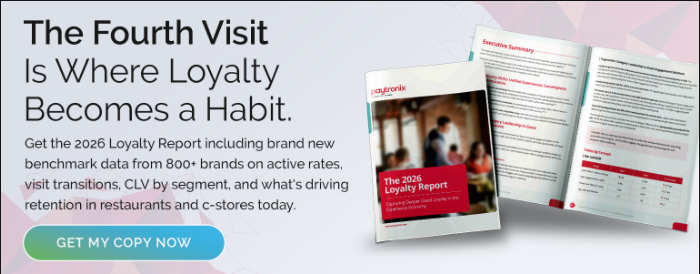
The 2026 Paytronix Loyalty Report, drawing on data from 800+ brands, reveals significant variance in active rates by restaurant concept type. Beverage & snack concepts, specialty restaurants, and sandwich/Mexican chains maintained active rates between 66% and 72%. Snack concepts had the standout year: active rates jumped 18% year-over-year, nearly doubling their share of engaged members.
For operators benchmarking their own programs: an active rate above 50% is strong. Below 30% signals a structural problem likely in enrollment rate, reward value, or messaging frequency, not a guest engagement problem. The platform you choose directly determines your ceiling on active rate.
What is the best loyalty software for restaurants?
The best restaurant loyalty software depends on your scale, existing tech stack, and program goals. For multi-unit and enterprise brands, Paytronix and PAR/Punchh offer the deepest capabilities: unified platforms combining loyalty, CRM, online ordering, and AI personalization.
For independent restaurants already on Toast or Square, the native loyalty modules provide a fast, low-cost starting point. The "best" platform is the one that matches your integration requirements, supports your program structure, and grows with your brand.
How much does restaurant loyalty software cost?
Pricing varies significantly by platform tier and feature set. Square Loyalty starts at approximately $49/month per location; the most accessible entry point.
Toast Loyalty's Marketing Essentials bundle runs approximately $185/month, bundled with gift cards and email marketing. Enterprise platforms including Paytronix, PAR/Punchh, Thanx, and Incentivio are custom-quoted based on location count, module selection, and contract terms.
For growing multi-unit brands, expect platform investments in the range of several hundred to several thousand dollars per month depending on scale.
Can restaurant loyalty software integrate with any POS?
Not all platforms integrate with all POS systems. Toast Loyalty and Square Loyalty only work within their respective ecosystems. Paytronix supports 30+ native POS integrations across the major platforms (Aloha, Brink, Oracle Simphony, and more) plus 450+ total integrations.
PAR/Punchh integrates natively with Brink POS and has a broad third-party integration library. Before shortlisting any platform, confirm your specific POS is supported natively.
What is the difference between a points-based and a tiered loyalty program?
A points-based program rewards guests with points per dollar spent or per visit, redeemable for discounts or free items once a threshold is reached. It's the most common structure, which is easy for guests to understand and easy for operators to manage.
A tiered program assigns guests to levels (e.g., Bronze, Silver, Gold) based on cumulative spend or visit frequency, with higher tiers unlocking progressively better rewards. Tiered programs drive aspirational spending behavior but require more guest engagement effort to maintain. Many enterprise brands run hybrid programs combining both approaches.
How do I measure the ROI of a restaurant loyalty program?
The core ROI metric is incremental revenue from loyalty members vs. non-members: the spend lift attributable to program participation, not just natural repeat visit behavior. Track: member vs. non-member average check, visit frequency lift, active rate (90-day), redemption rate, new member enrollment rate, and 90-day retention of newly enrolled members.
Most enterprise loyalty platforms provide dashboards that surface these metrics natively. Industry benchmarks: 90% of loyalty program operators report positive ROI, with an average return of 4.8x program cost.
What is the Fourth Visit Principle?
The Fourth Visit Principle is a Paytronix research finding that identifies guests who visit four or more times within a defined period as much more likely to become long-term, high-value customers. The principle has practical implications for program design: rather than treating loyalty enrollment as the primary goal, brands should treat the fourth visit as the activation milestone and build onboarding campaigns, milestone bonuses, and new-member journeys that accelerate guests to that threshold.
Should I choose a standalone loyalty platform or a POS-native module?
POS-native loyalty modules (Toast, Square) are faster to deploy and lower cost but they lock you into a single ecosystem and cap your program's sophistication. Standalone platforms (Paytronix, PAR/Punchh, Incentivio) require more implementation effort but offer deeper personalization, broader integration options, more program flexibility, and the ability to run across multiple POS systems or concepts. For brands with more than 10 locations or ambitions to scale, a dedicated loyalty platform almost always outperforms a POS-native module over a 3-year time horizon.
How do loyalty programs help restaurants compete with third-party delivery apps?
Third-party delivery platforms (DoorDash, Uber Eats, Grubhub) capture guest transaction data that brands never see, meaning restaurants lose the ability to market directly to those guests. A loyalty program that integrates with online ordering and in-store POS creates a direct guest relationship that bypasses the third-party intermediary.
Guests enrolled in the brand's own loyalty program have a direct incentive to order through the brand's own channels (app, web, POS) rather than a marketplace. Brands with strong loyalty programs consistently report higher rates of direct ordering channel conversion.
Ready to Compare Platforms for Your Brand?
Choosing the right restaurant loyalty platform is a significant decision and the right choice depends on your current tech stack, guest volume, and program goals. Paytronix works with restaurant and c-store brands of all sizes to assess fit, compare options, and design loyalty programs that drive measurable results.
Request a Personalized Demo
See how Paytronix compares against your specific requirements in a demo built around your brand.
→ Request a Demo Now
Sources
THE FOLLOWING SOURCES INFORMED THE DATA AND STATISTICS IN THIS ARTICLE.
- Paytronix. 2026 Loyalty Report: Capturing Deeper Guest Loyalty in the Experience Economy. April 2026. paytronix.com
- Paytronix. 2025 Annual Loyalty Report. 2025. paytronix.com
- Paytronix. Platform data: loyalty participation rates, 1:1 messaging effectiveness, member vs. non-member spend. 2025.
- Antavo. Global Customer Loyalty Report 2026. 2026. antavo.com
- Nation's Restaurant News. 76% of limited-service restaurants report loyalty-driven traffic increase in 2024. 2025. nrn.com
- Restroworks. Restaurant Loyalty Program Statistics. 2025. restroworks.com
- Restroworks. Restaurant Customer Retention Statistics. December 2025. restroworks.com
- Voucherify. 25 Essential QSR Loyalty Trends and Statistics. January 2026. voucherify.io
- National Restaurant Association. State of the Industry 2025. 2025. restaurant.org
- PAR Technology. Introducing PAR Engagement: Unified Guest Engagement Cloud. June 2025. partech.com
- PAR Punchh. 2025 Product Release Wrap-Up. January 2026. punchh.com
- Toast. Loyalty program documentation and pricing. 2025. pos.toasttab.com
- Daily Emerald. 3 Best Loyalty Program Software for Restaurants (2026 Comparison). April 2026.
- Queue-it. 117 Staggering Loyalty Program Statistics for 2026. January 2026. queue-it.com
- DontPayFull. Loyalty Program Statistics 2026. March 2026. dontpayfull.com

 Michelle Casey




 Michelle Casey : Jun 25, 2026